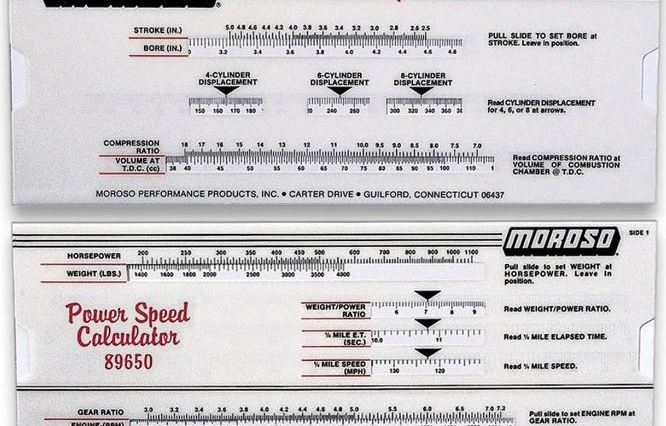
Auto Math 101
CUBIC INCH DISPLACEMENT BORE X BORE X STROKE X .7854 X # CYLINDERS 4.030 x 4.030 x 3.750 x .7854 x 8 = 382.6 ( 383 Chevy ) PISTON TO DECK CLEARANCE VOLUME BORE X BORE X 12.87 X … Continue reading Auto Math 101

CUBIC INCH DISPLACEMENT BORE X BORE X STROKE X .7854 X # CYLINDERS 4.030 x 4.030 x 3.750 x .7854 x 8 = 382.6 ( 383 Chevy ) PISTON TO DECK CLEARANCE VOLUME BORE X BORE X 12.87 X … Continue reading Auto Math 101

Ford used the 9 inch rear from around the 1957 model year right up until the early 1980’s in cars and trucks. It was not the only axle used, but was by far one of the best. Variations by Ford exist in the size of the outer axle bearings in the housings and carriers both, as well as with the spline count on the axle shafts. Generally most cars received the small axle bearings and 28 spline axle shafts. Exceptions to this were the ultra Hi performance Boss 302’s, Boss 429’s, 427’s, 428 CJ/SCJ and the 429 cars which received … Continue reading Ford 9 inch Tech

Dakota Digital Series III instrument systems offer the latest technologies and features for your custom vehicle. High brightness vacuum fluorescent displays provide a lifetime of trouble free use while offering increased accuracy and features! Full 6 Gauge Instrument System fits into OEM bezel for 1954 Mercury. Fits directly into existing bezel. (not included) Dakota Digital Continue reading 1954 Mercury Digital Instrument System

A few weeks ago, I mentioned that I was itching to get some tunes into my daily driven ’39 Ford Sedan. Installing a simple stereo in an old car is easy as pie, but this car presented a challenge of sorts. See, the ’39 still has the original interior and wood grained dash and come hell or high water, there was just no way I could talk myself into cutting anything on the car at all. Whatever I was gonna do, had to be completely hidden from sight and require zero hole drilling or cutting of any kind. I decided … Continue reading Hidden Tunes Via An Ipod
Gauge (ga) Standard Steel Thickness (inches) Galvanized Steel Thickness (inches) Aluminum Thickness (inches) 3 0.2391 0.2294 4 0.2242 0.2043 5 0.2092 0.1819 6 0.1943 0.1620 7 0.1793 0.1443 8 0.1644 0.1285 9 0.1495 0.1532 0.1144 10 0.1345 0.1382 0.1019 11 0.1196 0.1233 0.0907 12 0.1046 0.1084 0.0808 13 0.0897 0.0934 0.0720 14 0.0747 0.0785 0.0641 15 0.0673 0.0710 0.0571 16 0.0598 0.0635 0.0508 17 0.0538 0.0575 0.0453 18 0.0478 0.0516 0.0403 19 0.0418 0.0456 0.0359 20 0.0359 0.0396 0.0320 21 0.0329 0.0366 0.0285 22 0.0299 0.0336 0.0253 23 0.0269 0.0306 0.0226 24 0.0239 0.0276 … Continue reading Sheet Metal Gauge Chart

More displacement and greater leverage means more torque. This concept is obvious when you compare the torque ratings between factory small block motors and factory big block motors. However, nowadays it is not necessary to suffer the time and switching costs of leaping to a larger block if you are only after more displacement. Displacement is just a factor of bore and stroke, by increasing the stroke of your current motor Formula A. Displacement. Simply a factor of bore and stroke. Increase the stroke of your current motor and reap the benefits of more torque. you can enjoy the satisfaction … Continue reading Stroker Motors Explained
Love the look of classic pin-ups from the 1930s, ’40s and ’50s? Ever wondered what makeup tricks they use to get that perfectly flawless finish, those sultry bedroom eyes and those ruby red lips? Learn to do it yourself in this quick video tutorial, and you can look like a retro pin-up model, too! Continue reading HOW TO DO PIN-UP MAKEUP
Aluminum characteristics: The 3003-H14 has superior strength characteristics over pure aluminum and is easily welded with either TIG (tungsten-inert-gas) or oxygen-acetylene gas welders, yet remains malleable for shaping and bending. By comparison, a 6061-T6 aluminum alloy would yield even more strength than the 3003-H14, but the 6061-T6 is also more brittle and if welded, may develop stress cracks at the weld. Following is a list of aluminum alloys defined by a four-digit numeric code to identify the alloy content. The first digit represents the main element of the alloy. The alphanumeric code that follows the four digits (i.e “H14” or “T6”) is the … Continue reading Steel & Aluminum Characteristics
Here’s a straightforward way to build your own “Runtz” type voltage reducers so that you can use your 6 volt gauges on your 12 volt system. The regulator is based on the LM7806 integrated circuit, which is able to reduce voltage while maintaining a constant current. Use one regulator for each gauge; this allows you to keep each circuit separate which is useful for sorting any troubles you might have. While it is possible to use one regulator for all gauges using a power transistor, it has a bigger footprint and produces more heat, requiring it to be carefully mounted … Continue reading How to Build a Voltage Regulator for $3
 Greaseralley - 54 Mercury Sunvalley build